Thursday, 10 June 2010
Walking Directions on Tenerife – The Chinyero Volcano – Almost Perfect Signage…Almost
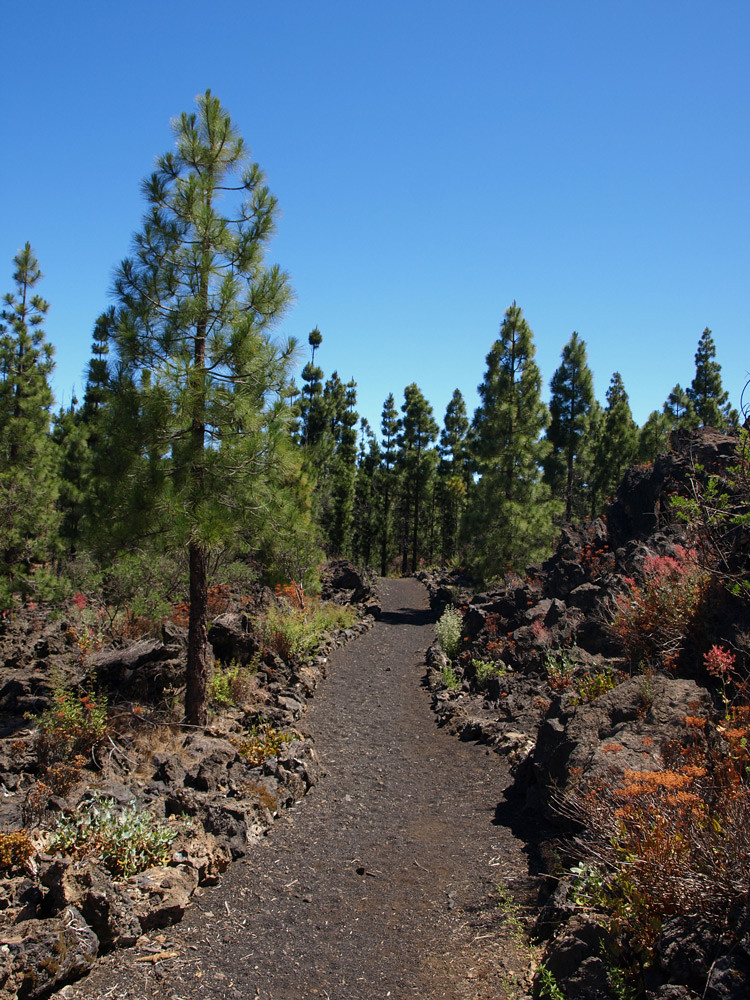
This week we thought we were going to have to eat our words about the lack of consistency regarding official walking signage on Tenerife when we ‘oohed’ and ‘aahed’ at the lovely brand new signs leading us to the Chinyero Volcano in the west of the island.
Admittedly getting to the actual walk had involved ignoring a signpost which suggested that the road to the start of the walk may or may not have been shut – it wasn’t – and then knowing where the actual walk began as the signposts didn’t start till we were on the walk. This sort of flawed thinking runs through a lot of Canarian thinking. You have to know that something exists, and where it exists to find out more info about it. It means that if you’re a visitor, there are a lot of things going on that you never get to hear about. Walking routes don’t just start at the first signpost.
But being already armed with this info, this potential stumbling block at the start didn’t pose a problem. To be honest, I didn’t even think about it until I started writing this. It’s something we have to remind ourselves of on a regular basis – to try to look at walks through the eyes of someone who isn’t overly familiar with Tenerife or its quirky little ways.
Anyway we set off along a new and very clear path and at every crossroads there were signs complete with distances. Okay, the angle of a couple might not have been perfect, but that’s being overly picky.
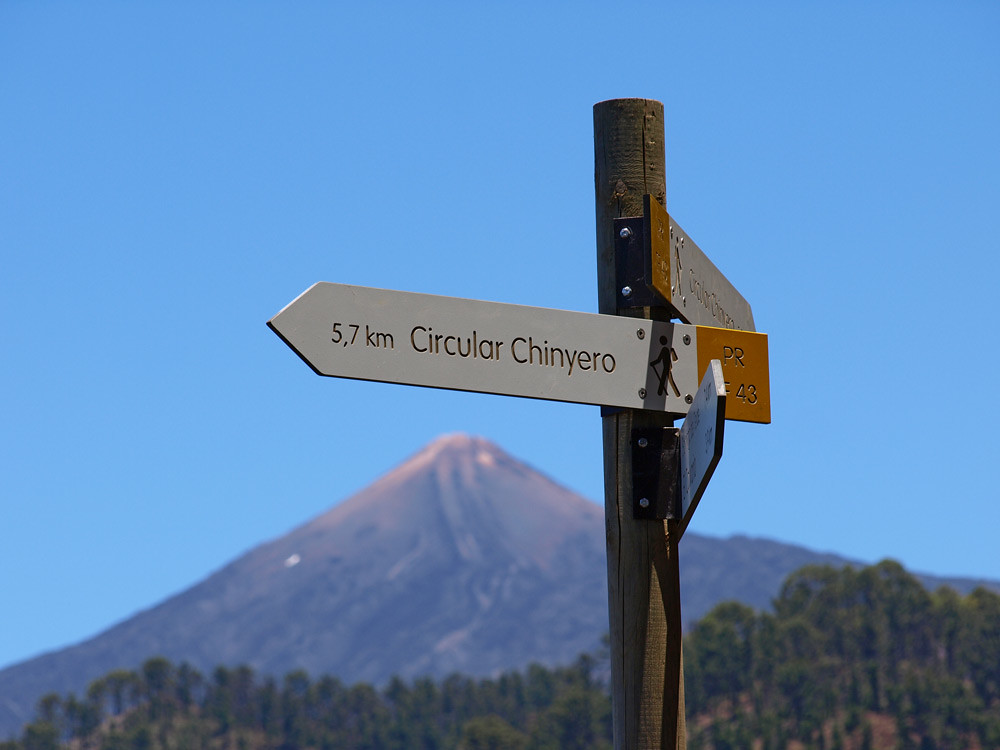
It was one of, if not the clearest marked walking route that we’ve experienced on Tenerife and was getting the thumbs up from us as the perfect walking route. This was looking like a shining example of what the future of Tenerife as a top walking destination could look like.
But this is Tenerife; where the illogical is almost compulsory. As we reached a point in the walk which was less than a couple of hundred yards from the Boca Tauce road and therefore a perfect spot for walkers to access the route from the south and south west, the path completely ignored this and continued parallel with the road before heading inland again.
Not only were there no signs from the path to the road, or vice versa, there were yellow and white crosses advising that it was definitely not part of the route.
Basically this was a walk which was perfectly laid out for people starting from the northern side of the island, but people on the southern side might not be aware it existed even though they were only metres from it. It was bizarre and I can’t quite figure out, considering the care and attention that went into signposting the rest of the walk, why there was such a serious omission at that point.
But there you go; ours is not to reason why, ours is but to do and…discover.
Monday, 31 May 2010
Walking on Tenerife – all that glistens is not gold.
We often get asked about walking routes in the west by people who are planning to holiday in and around Los Gigantes. So over the past couple of weeks we’ve been concentrating on that area and trying out some walks.
We knew that there was an old trading path running from somewhere around Guía de Isora up into the hills so last week we set off to find it. We were working off information supplied by the Ayuntamiento (Town Hall) which, as usual, was reprinted on a regular basis without anyone checking if it was still current.
Consequently, the start of the route had long since disappeared, replaced by new roads and walls.
After a precipitous false start and some hesitant exploration, we finally found the route and once we were on our way, were pleasantly surprised to find that it was in fact well signed and easy to navigate. At multiple path junctions, signposts gave good directions and distances, routes were way-marked with painted stripes and there were even information boards at various points, showcasing other routes.
Having enjoyed and chronicled a lovely, rural, circular route we emerged back into Guía alongside someone’s house, at the bottom of a dead end, accessed via a series of climbs, twists and turns through housing estates, with not a single signpost to mark it. Had we been looking to start the walk from that side, we would probably still be wandering around Guía now.
That same afternoon we drove further up into the hills to do a short(ish) route at the start of which a brand new, fancy sign had been erected by the Cabildo (Island Government).
Within metres of setting off from the sign, we were unsure of which way to go, our indecision hampered by two small dogs growling and snapping at our heels. Once we’d found an overgrown semblance of a path, it split off in different directions constantly with no marker signs for guidance. Although we were alongside a steep barranco (ravine) and so our direction was pretty obvious, finding the way through was proving to be impossible.
After aborted attempts to drop down dodgy trails on the side of the barranco, we finally found our path completely blocked by two parked vans alongside a house. Re-tracing steps; trying different trails and even asking a couple of locals all amounted to nothing. We finally gave up, tired and frustrated with feet embedded with sharp seed heads from wading through the tangled mass of undergrowth.
The Medio Ambiente (Environmental Department) had clearly decided to re-open the path and had begun by putting up the fancy sign. When, or if, they’ll get round to re-claiming the path from man and nature and giving it clear markings is anybody’s guess.
The moral of this tale is that, on Tenerife, you can’t tell a walk from its signpost.
Walking routes for the south west coming soon…
We knew that there was an old trading path running from somewhere around Guía de Isora up into the hills so last week we set off to find it. We were working off information supplied by the Ayuntamiento (Town Hall) which, as usual, was reprinted on a regular basis without anyone checking if it was still current.
Consequently, the start of the route had long since disappeared, replaced by new roads and walls.
After a precipitous false start and some hesitant exploration, we finally found the route and once we were on our way, were pleasantly surprised to find that it was in fact well signed and easy to navigate. At multiple path junctions, signposts gave good directions and distances, routes were way-marked with painted stripes and there were even information boards at various points, showcasing other routes.
Having enjoyed and chronicled a lovely, rural, circular route we emerged back into Guía alongside someone’s house, at the bottom of a dead end, accessed via a series of climbs, twists and turns through housing estates, with not a single signpost to mark it. Had we been looking to start the walk from that side, we would probably still be wandering around Guía now.
That same afternoon we drove further up into the hills to do a short(ish) route at the start of which a brand new, fancy sign had been erected by the Cabildo (Island Government).
Within metres of setting off from the sign, we were unsure of which way to go, our indecision hampered by two small dogs growling and snapping at our heels. Once we’d found an overgrown semblance of a path, it split off in different directions constantly with no marker signs for guidance. Although we were alongside a steep barranco (ravine) and so our direction was pretty obvious, finding the way through was proving to be impossible.
After aborted attempts to drop down dodgy trails on the side of the barranco, we finally found our path completely blocked by two parked vans alongside a house. Re-tracing steps; trying different trails and even asking a couple of locals all amounted to nothing. We finally gave up, tired and frustrated with feet embedded with sharp seed heads from wading through the tangled mass of undergrowth.
The Medio Ambiente (Environmental Department) had clearly decided to re-open the path and had begun by putting up the fancy sign. When, or if, they’ll get round to re-claiming the path from man and nature and giving it clear markings is anybody’s guess.
The moral of this tale is that, on Tenerife, you can’t tell a walk from its signpost.
Walking routes for the south west coming soon…
Friday, 28 May 2010
Walking in the Teide Crater – It's Tajinaste Time
They don't seem as though they belong. In an other-worldly setting they look like visitors from another planet themselves; their tall proud spikes standing out against the ruddy tones of the volcanic landscape like splashes of blood on a canvas.
It's easy to believe that they are extra-terrestrial visitors enjoying their annual couple of weeks in Tenerife's sunshine before heading back to who knows where.
If anyone hasn't seen them up close and personal then, at some point before mid June, it's worth making the trip up to Las Cañadas del Teide see the brief but spectacular blooming of the tajinaste plant.
Yesterday we traveled back from the south of Tenerife to Puerto de la Cruz via the crater, hoping that our timing was right and the fields of this unusual plant would be there to welcome us – we weren't disappointed.
As you drive along the roads from the southern entrances toward Mount Teide, the tajinaste aren't always easy to spot; they can behave like shy creatures, keeping just out of sight below ridges beside the road. But once you know where they are it's impossible to miss them and conveniently they come back to the same spots year after year. They also congregate around the cable car like the human visitors to Tenerife and by the time you're on the road north, they've lost their shyness and huddle around miradors (viewing areas) and stand at the side of the road like flamboyant hitch-hikers.
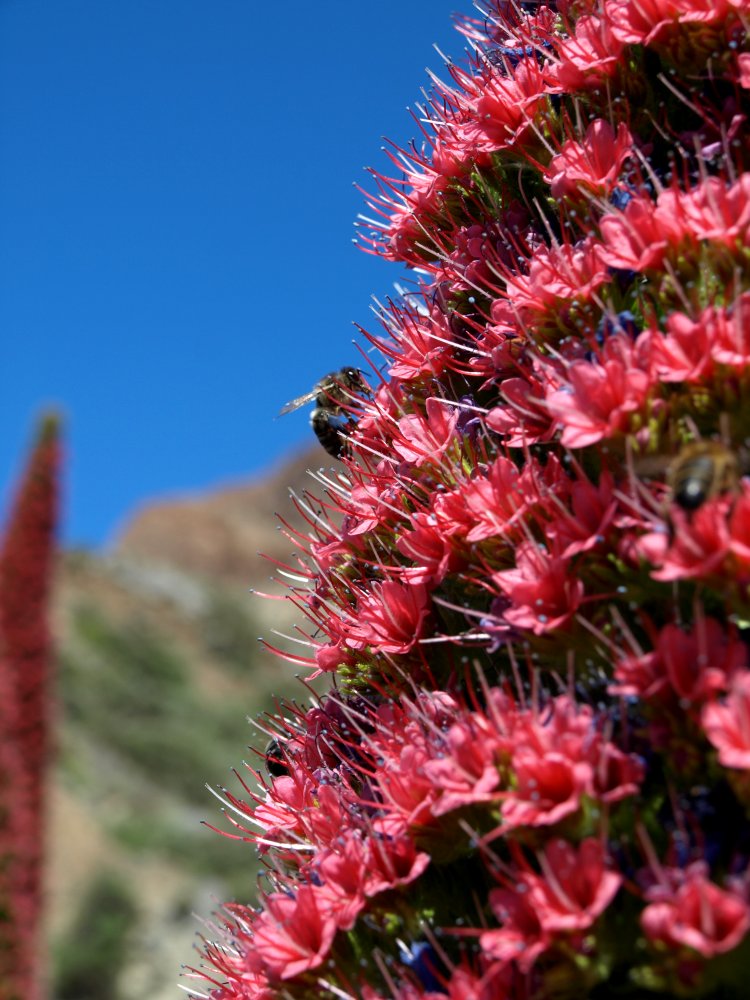
But it's essential to get in amongst them by foot to really appreciate their uniqueness. We must have timed it perfectly this year as the island's bees were enjoying their annual shopping trip to the tajinaste – the black spots in the picture aren't dust on the camera lens – and the air was alive with excited buzzing as I leaned in close to try to get some intimate shots of the bees on the flowers. I wasn't particularly concerned that bees were buzzing around my head; there was only one thing on their little insect radar and it wasn't me. I was able to take photo after photo without fear of getting zapped by a bee.
Visiting the tajinaste in bloom is one of those unique little experiences that makes walking on Tenerife ultra special and witnessing these amazing plants bloom in such spectacular style in such a dry, violent landscape makes the soul soar. I can't recommend it enough.
It's easy to believe that they are extra-terrestrial visitors enjoying their annual couple of weeks in Tenerife's sunshine before heading back to who knows where.
If anyone hasn't seen them up close and personal then, at some point before mid June, it's worth making the trip up to Las Cañadas del Teide see the brief but spectacular blooming of the tajinaste plant.
Yesterday we traveled back from the south of Tenerife to Puerto de la Cruz via the crater, hoping that our timing was right and the fields of this unusual plant would be there to welcome us – we weren't disappointed.
As you drive along the roads from the southern entrances toward Mount Teide, the tajinaste aren't always easy to spot; they can behave like shy creatures, keeping just out of sight below ridges beside the road. But once you know where they are it's impossible to miss them and conveniently they come back to the same spots year after year. They also congregate around the cable car like the human visitors to Tenerife and by the time you're on the road north, they've lost their shyness and huddle around miradors (viewing areas) and stand at the side of the road like flamboyant hitch-hikers.
But it's essential to get in amongst them by foot to really appreciate their uniqueness. We must have timed it perfectly this year as the island's bees were enjoying their annual shopping trip to the tajinaste – the black spots in the picture aren't dust on the camera lens – and the air was alive with excited buzzing as I leaned in close to try to get some intimate shots of the bees on the flowers. I wasn't particularly concerned that bees were buzzing around my head; there was only one thing on their little insect radar and it wasn't me. I was able to take photo after photo without fear of getting zapped by a bee.
Visiting the tajinaste in bloom is one of those unique little experiences that makes walking on Tenerife ultra special and witnessing these amazing plants bloom in such spectacular style in such a dry, violent landscape makes the soul soar. I can't recommend it enough.
Wednesday, 26 May 2010
Walking on Tenerife – Those Boots Were Made For Walking
My favourite boots are a pair of old Camel boots that I've probably worn about twenty times. I was completely seduced by an advert in a travel magazine which basically showed a foot resting on a log in a clearing in the jungle. On the foot was a gleaming Camel boot which looked about as at home in that exotic setting as a piece of leather, not actually on an animal, could be. I couldn't resist them.
Their first outing was to Kenya where they seemed just the ticket for exploring Tsavo East on foot. The reality though was that, as walking boots go, they turned out to be a complete bust. They might have looked the part, but just walking from the safari lodge bar to a table overlooking a watering hole with a G&T (don't actually drink the stuff, but it did seem appropriate) to enjoy sunset was enough to bring up a blister. In the end I carried them around Kenya instead of them carrying me.
Since then I've learned to choose my footwear carefully when it comes to buying shoes for practical reasons; something that when you're tackling Tenerife's diverse range of landscapes is a far more sensible approach.
Footwear for Walking on Tenerife
My number one walking boots for donkey's years have been a trusty pair of brasher's, similar to their current Hillmaster boot. I brought them from Britain with me and they've proved equal to the task of tackling all of Tenerife's terrains from the sliding volcanic scree on the way to the summit of Mount Teide to pine covered forest floors in the forests of the Orotava Valley and icy slopes in Las Cañadas del Teide.
These sort of sturdy boots are good all rounders for exploring the island on foot. But mine can feel quite heavy in the summer months when the temperature rises off the scale and boots like the brasher can make my feet feel as though they're a wee bit overdressed.
So when the temperatures rise, and the terrain permits, I tend to switch to a walking sandal. For a long time I wore a pair of Merrells when walking in summer months (between May and the end October) in areas where the ascents weren't too steep or slippery (good for coastal walks). They struggled a bit with some of the terrain, especially in the upper La Orotava Valley where a bit of dry floor ski-ing can add some excitement to trails when the forest floor is thick with pine needles. It was on one such walk that one of them fell apart mid-walk (to be fair I'd had them for a few years and they'd seen some action).
I couldn't find a suitable replacement until I spotted what looked like an almost identical pair of sandals in my local supermarket at a fraction of the price. To be honest I didn't expect much of them and tried them out on a short coastal walk around Las Ramblas in Los Realejos to see how they'd hold up. It turned out they felt no different from my old Merrells and two years later they're still going strong. They were an incredible bargain considering they cost me €2.99.
Recently I added another addition to my walking footwear stable, a pair of Quechua lightweight walking shoes. I could feel my feet sigh with joy as I tried them out for the first time on a trek last week. The temperature was hovering around 30 degrees and the terrain was more uneven than I'd expected with a couple of steep ascent/descents but the shoes stuck to the path as though they had solvent on them. After 15 kilometres my feet and the shoes were still best of mates.
The only downside was that they were so comfortable that at the end of the walk I was denied that delicious pleasure of peeling off my boots and walking socks and slipping them into an airy pair of sandals to let them breathe a sigh of relief.
It was only their first outing, they'll get the second tomorrow, so it'll be interesting to see how they hold up over the long term.
They won't be sturdy enough for the most serious walks like climbing Teide, or even the muddy Anaga paths after the winter rains, but it looks as though the brashers are going to get a well earned rest over the summer.
Their first outing was to Kenya where they seemed just the ticket for exploring Tsavo East on foot. The reality though was that, as walking boots go, they turned out to be a complete bust. They might have looked the part, but just walking from the safari lodge bar to a table overlooking a watering hole with a G&T (don't actually drink the stuff, but it did seem appropriate) to enjoy sunset was enough to bring up a blister. In the end I carried them around Kenya instead of them carrying me.
Since then I've learned to choose my footwear carefully when it comes to buying shoes for practical reasons; something that when you're tackling Tenerife's diverse range of landscapes is a far more sensible approach.
Footwear for Walking on Tenerife
My number one walking boots for donkey's years have been a trusty pair of brasher's, similar to their current Hillmaster boot. I brought them from Britain with me and they've proved equal to the task of tackling all of Tenerife's terrains from the sliding volcanic scree on the way to the summit of Mount Teide to pine covered forest floors in the forests of the Orotava Valley and icy slopes in Las Cañadas del Teide.
These sort of sturdy boots are good all rounders for exploring the island on foot. But mine can feel quite heavy in the summer months when the temperature rises off the scale and boots like the brasher can make my feet feel as though they're a wee bit overdressed.
So when the temperatures rise, and the terrain permits, I tend to switch to a walking sandal. For a long time I wore a pair of Merrells when walking in summer months (between May and the end October) in areas where the ascents weren't too steep or slippery (good for coastal walks). They struggled a bit with some of the terrain, especially in the upper La Orotava Valley where a bit of dry floor ski-ing can add some excitement to trails when the forest floor is thick with pine needles. It was on one such walk that one of them fell apart mid-walk (to be fair I'd had them for a few years and they'd seen some action).
I couldn't find a suitable replacement until I spotted what looked like an almost identical pair of sandals in my local supermarket at a fraction of the price. To be honest I didn't expect much of them and tried them out on a short coastal walk around Las Ramblas in Los Realejos to see how they'd hold up. It turned out they felt no different from my old Merrells and two years later they're still going strong. They were an incredible bargain considering they cost me €2.99.
Recently I added another addition to my walking footwear stable, a pair of Quechua lightweight walking shoes. I could feel my feet sigh with joy as I tried them out for the first time on a trek last week. The temperature was hovering around 30 degrees and the terrain was more uneven than I'd expected with a couple of steep ascent/descents but the shoes stuck to the path as though they had solvent on them. After 15 kilometres my feet and the shoes were still best of mates.
The only downside was that they were so comfortable that at the end of the walk I was denied that delicious pleasure of peeling off my boots and walking socks and slipping them into an airy pair of sandals to let them breathe a sigh of relief.
It was only their first outing, they'll get the second tomorrow, so it'll be interesting to see how they hold up over the long term.
They won't be sturdy enough for the most serious walks like climbing Teide, or even the muddy Anaga paths after the winter rains, but it looks as though the brashers are going to get a well earned rest over the summer.
Monday, 24 May 2010
Organised Walks – A Bee's View of Mount Teide
Here's an interesting little guided walking route – El Teide A Vista De Abeja. It's based around an area which is a magnet to bees-the Fasnia Volcano, and is as much about the flora, bees and honey as it is about enjoying the stunning scenery.
There are limited places available and a €15 fee includes transport from La Laguna. The 7 km walk takes place on Saturday 29th May; the perfect time for a walk in the crater as the tajinaste should be in full bloom.
For more information call the Tenerife Rural office on 922 531 013
There are limited places available and a €15 fee includes transport from La Laguna. The 7 km walk takes place on Saturday 29th May; the perfect time for a walk in the crater as the tajinaste should be in full bloom.
For more information call the Tenerife Rural office on 922 531 013
Creating A Barrier Free Paradise – Tenerife's First Wheelchair Friendly Path
Last week the first wheelchair friendly forest path was opened by Tenerife president, Ricardo Melchior in Tacoronte's highlands.
The specially developed path is in Agua García, next to the Barranco de Toledo, and covers a distance of 860 metres (both ways) through the forest.
It might only be a small concession to opening up Tenerife's countryside to people who may not otherwise be able to enjoy it, but it is a commendable one.
The specially developed path is in Agua García, next to the Barranco de Toledo, and covers a distance of 860 metres (both ways) through the forest.
It might only be a small concession to opening up Tenerife's countryside to people who may not otherwise be able to enjoy it, but it is a commendable one.
Friday, 21 May 2010
Walking on Tenerife – Into the Unkown; South West Tenerife
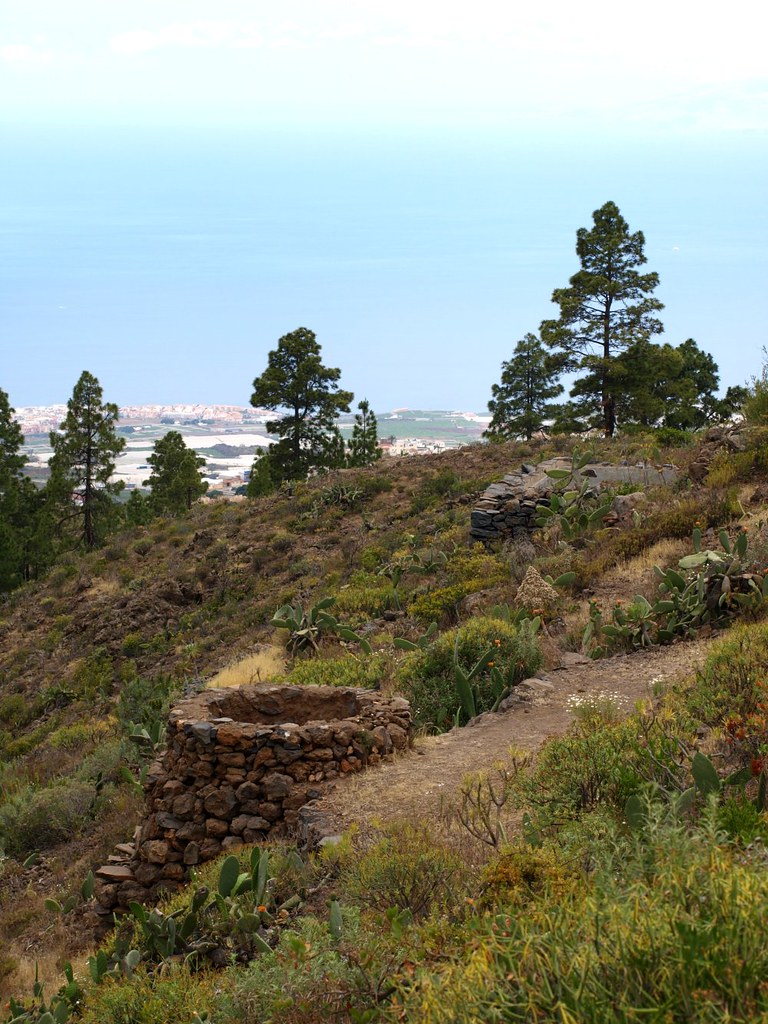
I get excited by the thought of walking in areas that you rarely hear mentioned, so when we parked the car in a hamlet above Tenerife's south west and headed to what we had worked out would be the start of the new walking route we were researching, I had mixed emotions when we were faced with a shiny new board with information about the route.
I say mixed emotions because on the one hand I wanted to feel we were exploring territory which is generally ignored even by the island's most enthusiastic walkers. On the other it was good to see that the local council were recognising that walking on Tenerife has enormous potential and providing signs to help walkers find their way around this wonderfully diverse island is a step in the right direction.
Within a hundred yards we realised that whilst the board was a step, it was a baby-sized one. Ahead of us were three paths; none signposted. It turned out that the signpost at the start of the route was the one and only signpost along an old merchants' trail which skirted abandoned houses and terraces, with potential paths leading off in various directions along the way.
Six years ago, when we first started exploring Tenerife on foot, I'd have been flummoxed by the lack of clarity regarding the way ahead. But experience since then of not relying on signs, trusting our instincts, and learning to spot the merest hint of a path hidden by the overgrown undergrowth has made us a bit wiser. I say a bit - there are still times when Tenerife's maze of trails confound, that's when the old compass comes in handy.
As it happened we successfully found our way to our objective, a partly abandoned valley hidden in the folds of the hills without use of the compass. And to be truthful, the lack of sign posts and directions on many Tenerife walking routes adds a buzz to finding our way to places which are way, way off the beaten track.
However, visitors to Tenerife who fancy exploring its rural delights and head off along a signposted trail to find themselves faced with tracks heading in all directions and no more signposts to show the way, may not agree that 'buzz' is an accurate description of the emotion they feel at that point.
Subscribe to:
Posts (Atom)